Panel and study · 18 of 28
Cosmo come corpo vivente
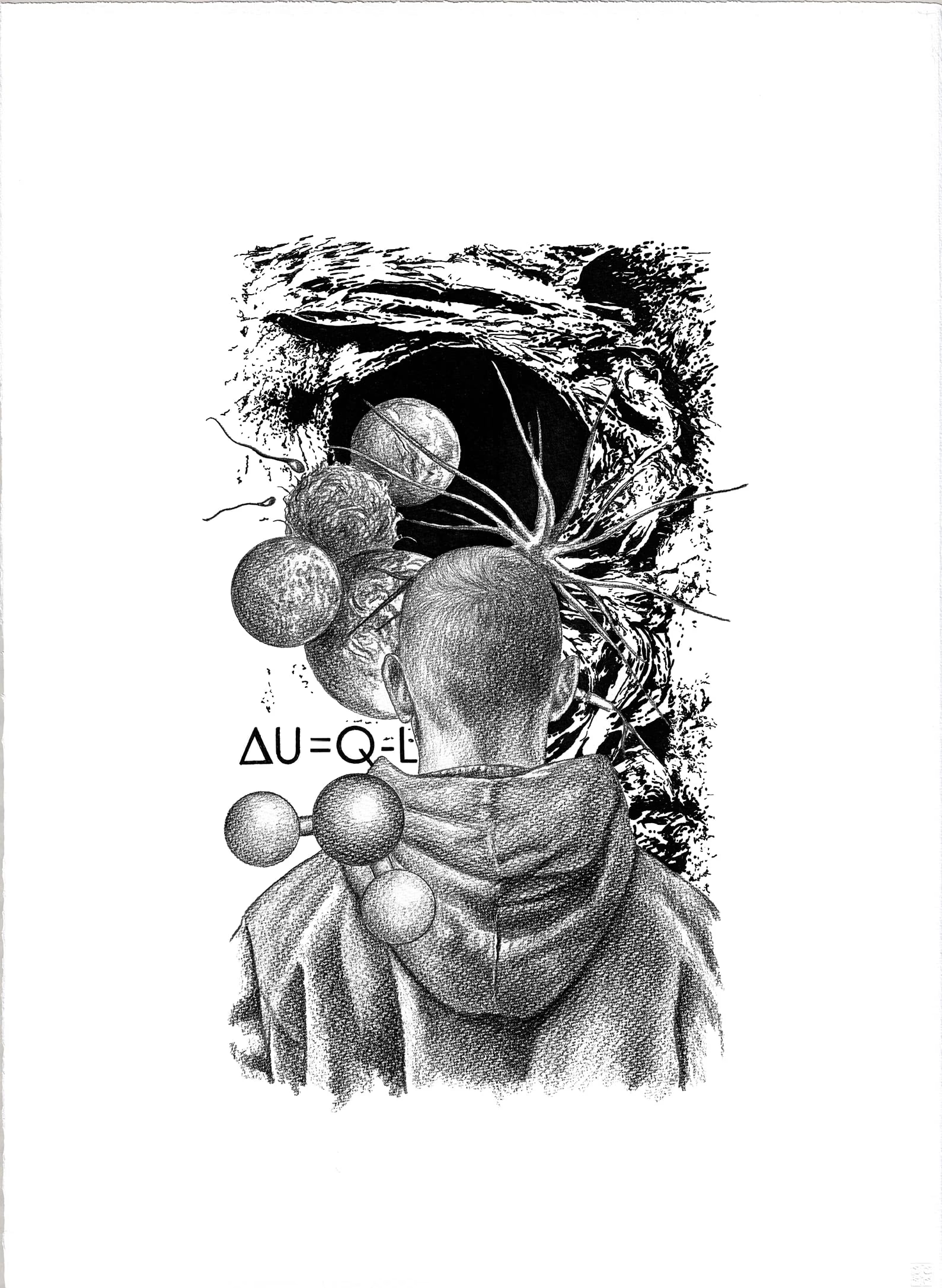
Credits: Giorgio Lupattelli / Scrinium.
Francis is immersed in a universe in which cosmic elements and forms of life share the same space: planets, water, neurons, cells and matter appear to belong to a single organism. In the background, the work of Alberto Burri introduces the theme of origin and transformation. The composition suggests that life is a continuous process, in which every passage takes part in a greater order.
Giorgio Lupattelli
Cosmo come corpo vivente
2026, Mixed media: charcoal, pencil, ink, watercolour on laid paper with untrimmed edges, cm. 50 x 70 (approx.)
- Room
- Sale di Messalina, Room 2
- Sequence in the exhibition
- 18 of 28
- Inventory
- OP-002
- Credits
- Giorgio Lupattelli / Scrinium
- Rights
- Rights of use, exhibition and reproduction: Scrinium.
In depth
The work offers a unified vision of reality. Francis does not observe the cosmos from outside: he is an integral part of it. Around him coexist celestial bodies, water molecules, germ cells and a neuron, images that belong to very different scales of existence yet are brought back to a single vital principle.
The artist thus constructs a dialogue between the universe and biological life, suggesting that what happens in the infinitely large and in the infinitely small belongs to one and the same fabric of relations.
In the background appears a reference to the work of Alberto Burri. Its dark surface can be read as a threshold: a place from which everything seems to emerge or into which everything seems to return. Rather than representing a physical space, it introduces a reflection on origin, on transformation and on the mystery that accompanies every form of existence.
The presence of the formula of the First Law of Thermodynamics extends this perspective further. In physics, energy is neither created nor destroyed, but is continuously transformed. Set within the context of the work, this scientific law enters into dialogue with the Franciscan vision of existence, in which death does not represent an annihilation but a passage.
THEOPHANIA does not propose an overlapping of science and faith, nor does it seek to demonstrate a correspondence between different languages. The work rather places in relation perspectives which, though arising in different fields, share the same question about the meaning of life, of matter and of transformation.
Francis thus becomes the point of balance between these languages. His presence invites us to contemplate the cosmos as a living organism, in which every element finds meaning in its relation to the others. The universe does not appear as a set of isolated parts, but as a dynamic reality that continually transforms itself while maintaining its own unity.
OP-014 · Ink on paper · cm 29,7 x 42
The preparatory study
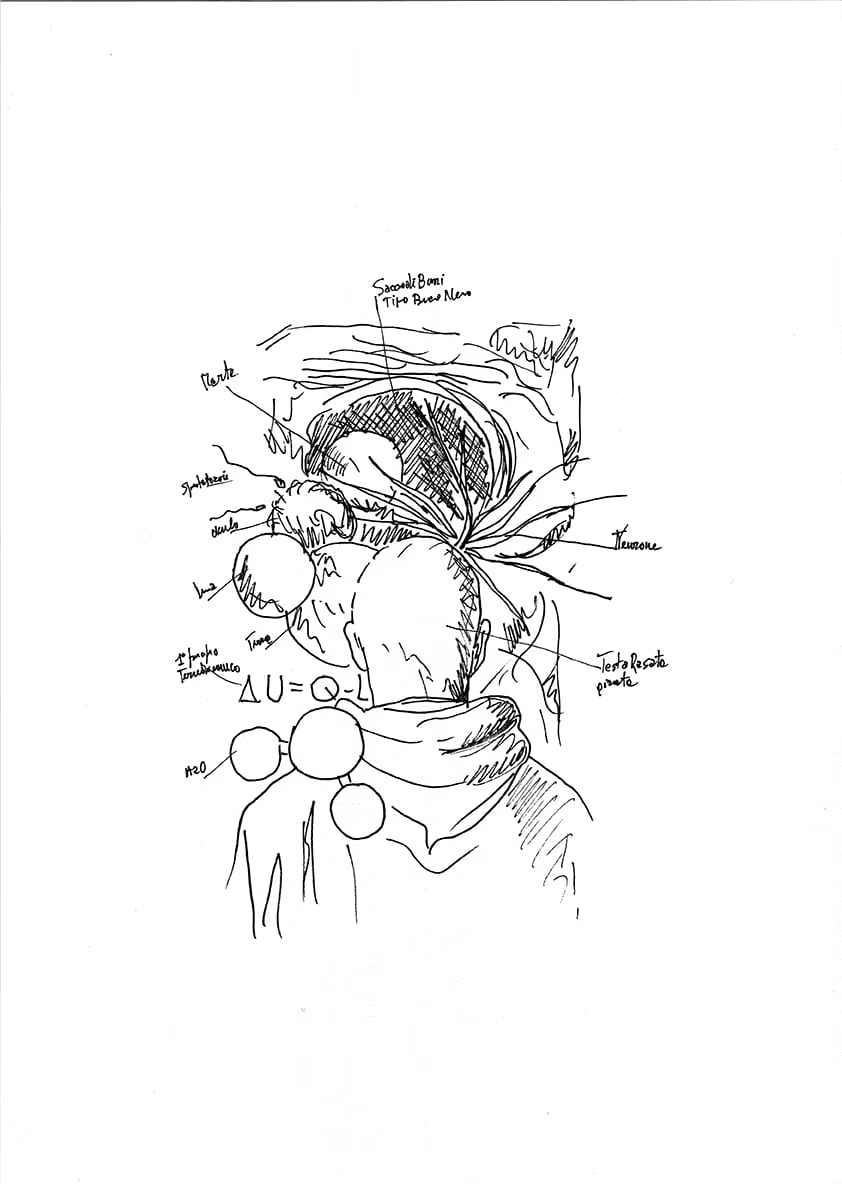
The sheet from which the panel is born: the same composition still in the state of line, with the artist’s handwritten notes naming the symbols before they become image.
Giorgio Lupattelli
Study for Cosmo come corpo vivente
2026, Ink on paper, cm 29,7 x 42
- Room
- Sale di Messalina, Room 1
- Sequence in the exhibition
- 6 of 28
- Inventory
- OP-014
- Credits
- Giorgio Lupattelli / Scrinium
- Rights
- Rights of use, exhibition and reproduction: Scrinium.