Panel and study · 17 of 28
Unus
Credits: Giorgio Lupattelli / Scrinium.
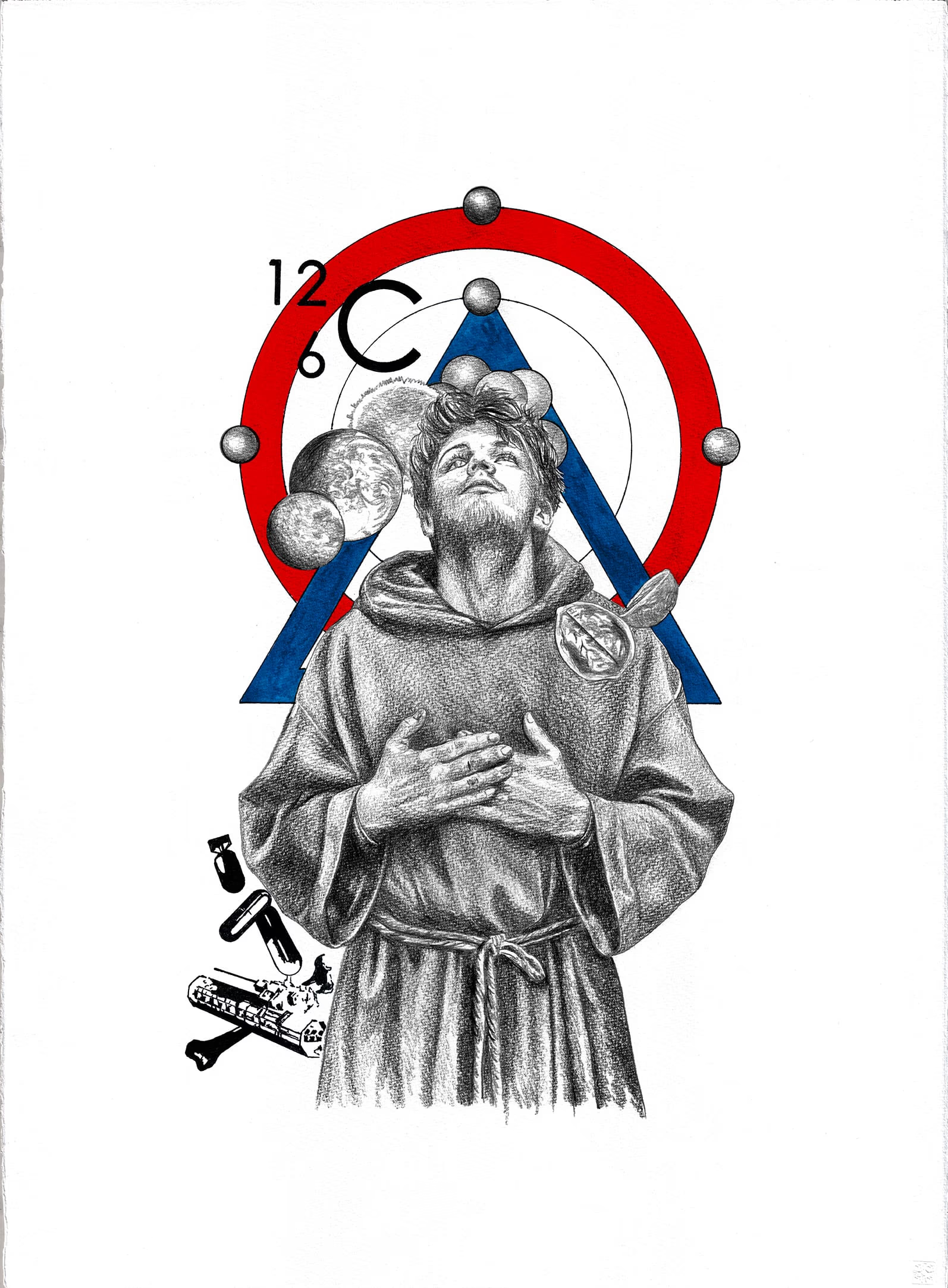
Francis stands before the carbon atom, the element at the basis of known life. Around him are interwoven references to cosmology, geometry, science and contemporary art. The work suggests that the same principle of order runs through the infinitely small and the infinitely large, inviting us to read reality as a system of relations. Francis thus becomes the meeting point between knowledge, creativity and human responsibility.
Giorgio Lupattelli
Unus
2026, Mixed media: charcoal, pencil, ink, watercolour on laid paper with untrimmed edges, cm. 50 x 70 (approx.)
- Room
- Sale di Messalina, Room 2
- Sequence in the exhibition
- 17 of 28
- Inventory
- OP-001
- Credits
- Giorgio Lupattelli / Scrinium
- Rights
- Rights of use, exhibition and reproduction: Scrinium.
In depth
The work sets out from an apparently simple image: Francis stands before the representation of a carbon atom, the chemical element that forms the basis of known life.
The choice is not accidental. The artist places the infinitely small in relation to the infinitely large. Just as electrons orbit the nucleus of the atom, so the Earth gravitates around the Sun and the Moon around the Earth. Different scales of reality appear to respond to one and the same principle of order.
Around this intuition a constellation of references belonging to different disciplines unfolds.
The opened walnut, holding a brain within it, recalls Stephen Hawking’s The Universe in a Nutshell and introduces the theme of knowledge as a continuous search for the origin and the structure of the universe.
The circle and the triangle belong as much to symbolic tradition as to the language of contemporary art. They recall the research of Sol LeWitt, a central figure of Minimalism and an artist deeply connected with the city of Spoleto, creating a dialogue between art history and geometric language.
The composition is completed by certain elements of the contemporary world: pills, a bomb and the reference to Stanley Kubrick’s 2001: A Space Odyssey, evoked through the transformation of the primordial bone into a technological instrument. These are images that question the human capacity to direct knowledge towards construction or towards destruction.
Francis remains at the centre of this system of relations. He is not presented as a merely historical figure, but as a presence capable of holding together different languages: science, art, symbol and spirituality.
The work suggests that knowledge does not belong to a single disciplinary field. Every form of knowledge acquires meaning when it enters into relation with the others. From this perspective, THEOPHANIA offers a contemporary reading of the Franciscan message: reality manifests itself as a complex unity, in which every element points to a wider order that invites human beings to know, to safeguard and to take responsibility for their own choices.
OP-013 · Ink on paper · cm 29,7 x 42
The preparatory study
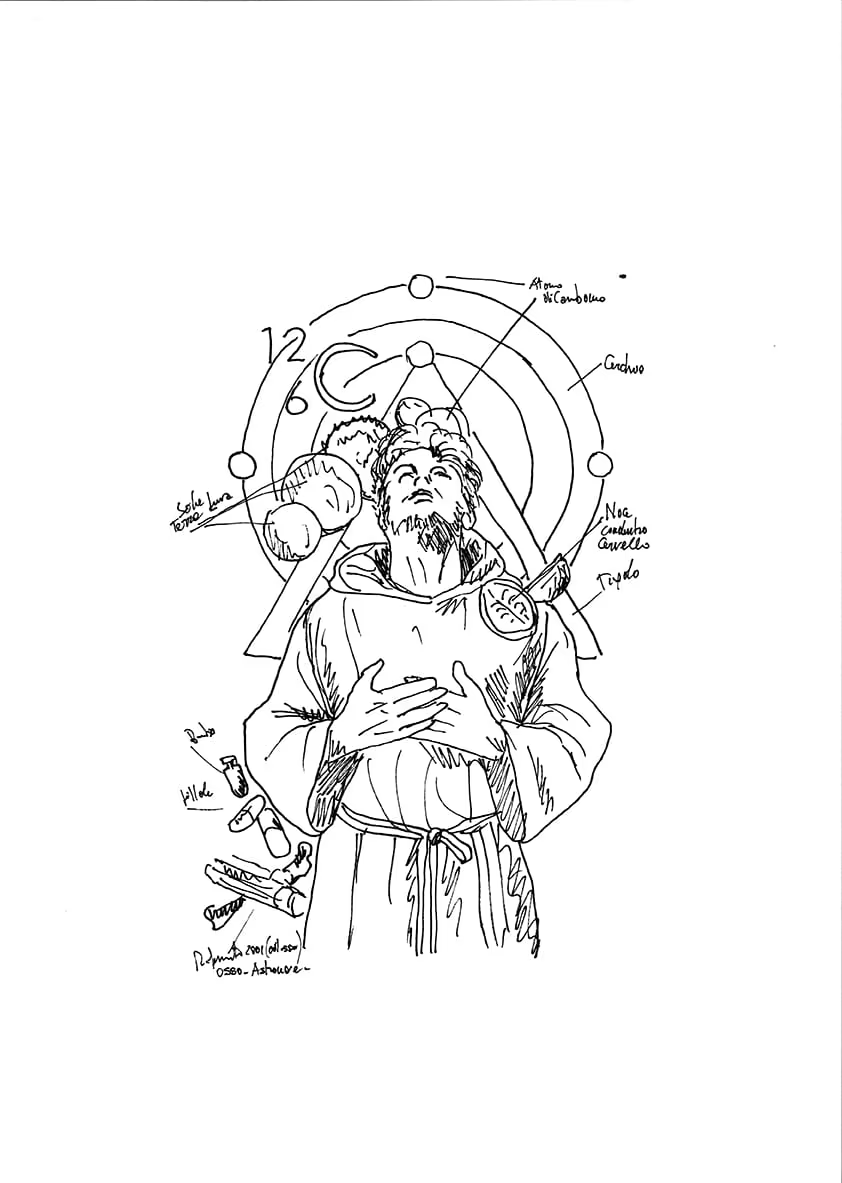
The sheet from which the panel is born: the same composition still in the state of line, with the artist’s handwritten notes naming the symbols before they become image.
Giorgio Lupattelli
Study for Unus
2026, Ink on paper, cm 29,7 x 42
- Room
- Sale di Messalina, Room 1
- Sequence in the exhibition
- 5 of 28
- Inventory
- OP-013
- Credits
- Giorgio Lupattelli / Scrinium
- Rights
- Rights of use, exhibition and reproduction: Scrinium.