Major work · 2 of 28
THEOPHANIA
Humility
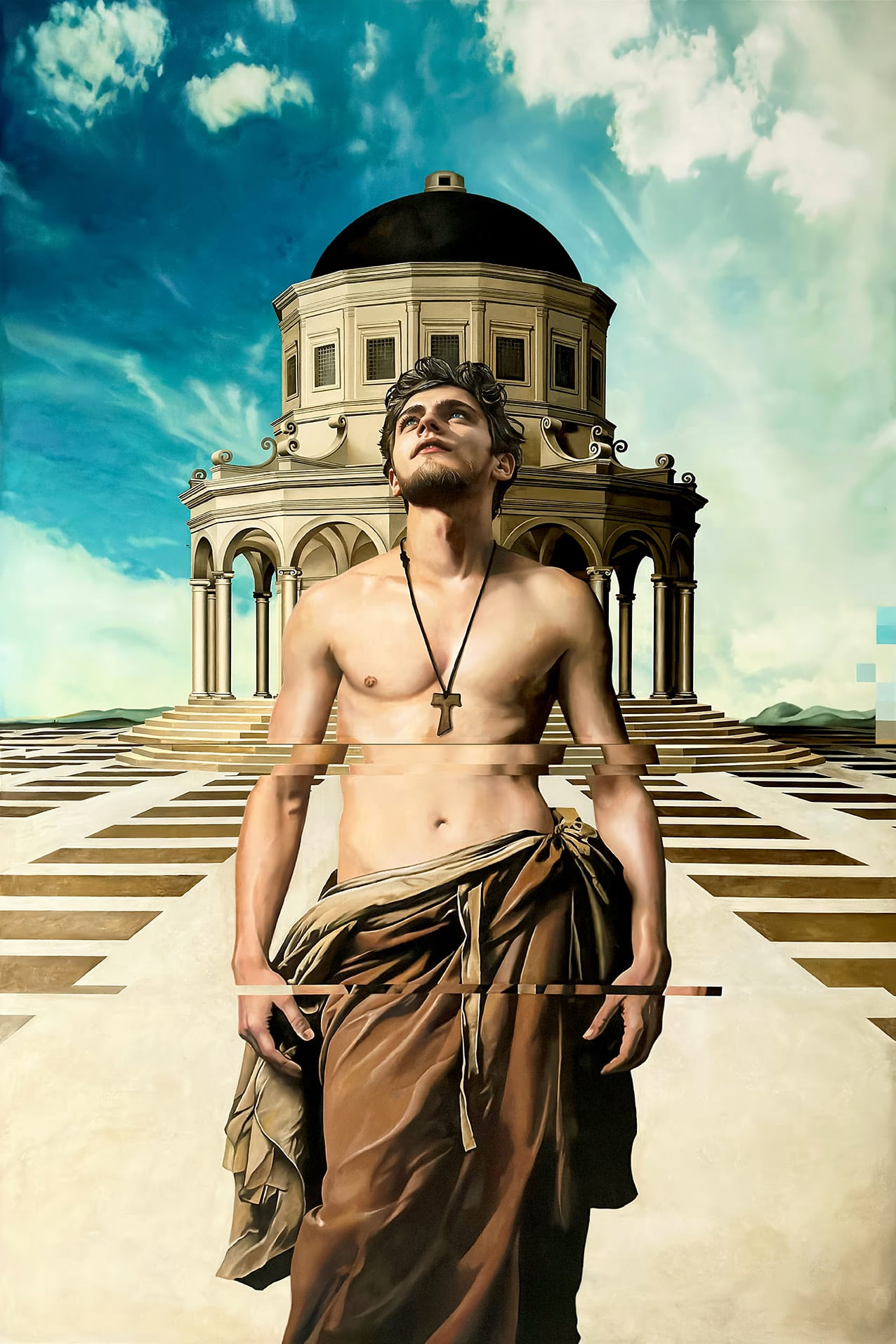
Credits: Giorgio Lupattelli / Scrinium.
The journey of Francis begins with a gesture of emptying. Turned towards the light and with his back to the temple inspired by Raffaello’s Marriage of the Virgin, he leaves behind what once defined him in order to receive a new identity. The work speaks of humility not as mortification, but as the inner space in which a person becomes free to encounter what is true.
Giorgio Lupattelli
THEOPHANIA (Humility)
2026, Oil on canvas, cm. 120 x180
- Room
- Sale di Messalina, Room 1
- Sequence in the exhibition
- 2 of 28
- Inventory
- OP-026
- Credits
- Giorgio Lupattelli / Scrinium
- Rights
- Rights of use, exhibition and reproduction: Scrinium.
In depth
The first panel of the triptych represents the moment in which Francis decides to abandon everything that until then had defined his own identity. It is not only the renunciation of material goods that lies at the centre of the work, but a deeper movement: the emptying of the self.
The artist portrays Francis as he strips himself, his gaze turned towards the light. The body is oriented in a precise direction, while behind him remains the temple inspired by Raffaello’s Marriage of the Virgin, which in turn takes up the celebrated composition by Perugino.
The temple does not represent a negative element. It is the symbol of an order already built, of a stable reality, of the history and the institutions within which a person grows and is formed. Francis neither destroys it nor repudiates it. He simply moves beyond it.
The emptying is born precisely here.
It does not consist in the rejection of things, but in the willingness to be defined by them no longer.
For this reason humility does not coincide with the diminishment of the person. On the contrary, it represents the condition that allows a person to recover their authentic measure.
The light towards which Francis turns his gaze is not yet a goal attained. It is a presence that calls him. The work speaks of the moment in which the search prevails over security, the future over possession, relationship over property.
THEOPHANIA thus interprets one of the most celebrated episodes in the life of Francis from a profoundly contemporary perspective. Every authentic change requires a form of emptying. Every transformation calls for the courage to leave behind whatever prevents a person from recognising their own vocation.
The Renaissance composition chosen by Giorgio Lupattelli reinforces this reading. The geometric balance of the temple engages in dialogue with the movement of the body of Francis, creating a tension between what appears complete and what instead is coming into being.
The first panel of the triptych thus becomes the threshold of the entire itinerary of THEOPHANIA.
It does not simply introduce the figure of Francis.
It introduces the very method of the journey.
Before any knowledge, before any transformation, even before the contemplation of creation, there is an inner space waiting to be set free.
The emptying does not impoverish the person.
It makes them available to welcome what they do not yet know.
It is in this availability that humility is born.