Major work · 3 of 28
THEOPHANIA
Salvation
Credits: Giorgio Lupattelli / Scrinium.
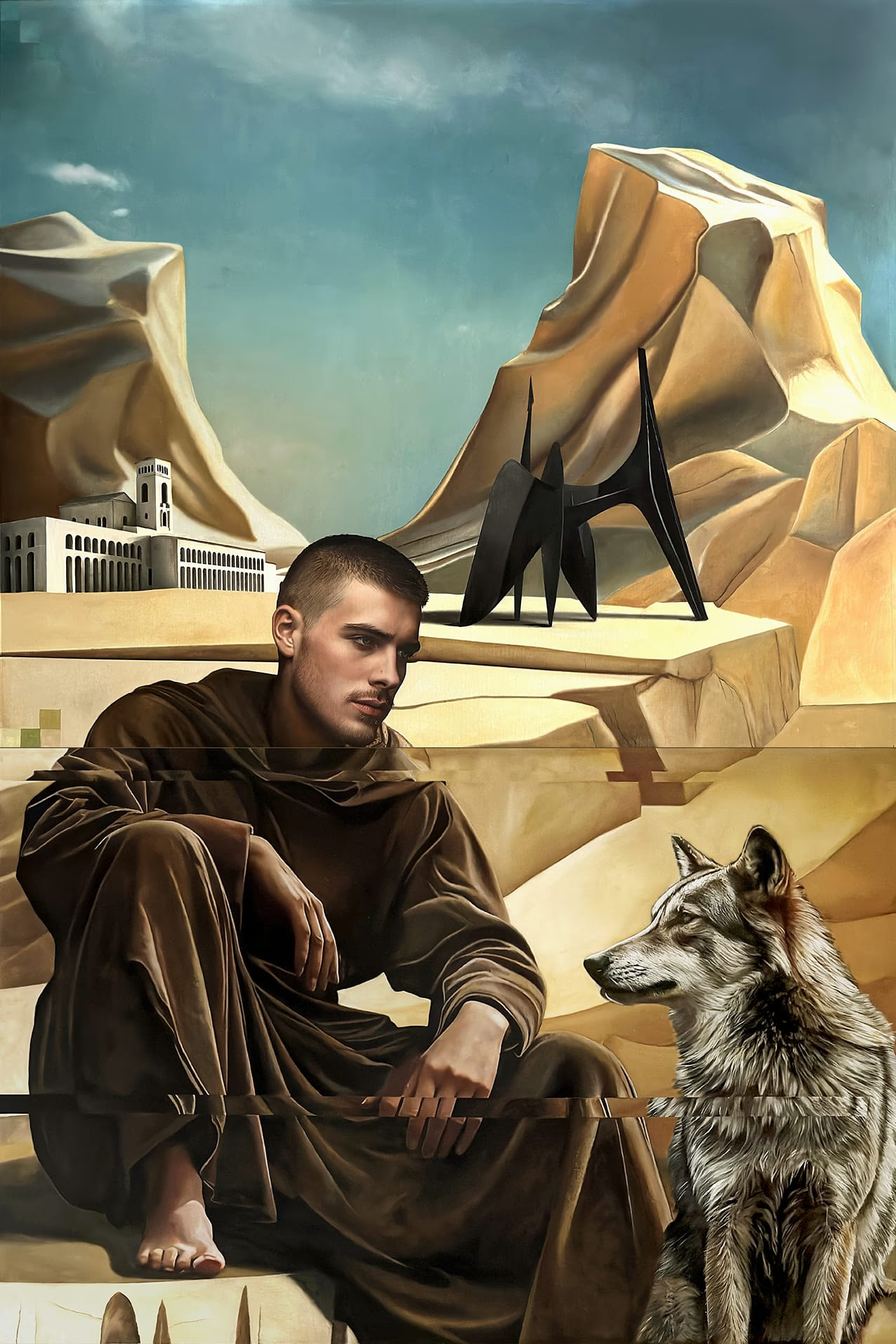
Francis walks through a landscape inspired by Giotto’s frescoes in Assisi, accompanied by the wolf, symbol of reconciliation. In the background appears the Teodelapio by Alexander Calder, a contemporary presence that binds the Umbrian landscape to the city of Spoleto. The work suggests that salvation does not coincide with a flight from the world, but with a recovered harmony between humanity, nature and history.
Giorgio Lupattelli
THEOPHANIA (Salvation)
2026, Oil on canvas, cm. 120 x180
- Room
- Sale di Messalina, Room 1
- Sequence in the exhibition
- 3 of 28
- Inventory
- OP-027
- Credits
- Giorgio Lupattelli / Scrinium
- Rights
- Rights of use, exhibition and reproduction: Scrinium.
In depth
After the emptying represented in the first panel, the journey of Francis enters a new phase. Renunciation gives way to encounter.
The artist builds this scene by drawing on the great landscapes of Giotto’s frescoes in the Upper Basilica of Assisi. This is not a stylistic quotation, but a reference to the birth of a new way of looking at the world. In Giotto’s cycles the landscape ceases to be mere background and becomes an integral part of the narrative.
In THEOPHANIA too the landscape takes part in the experience of Francis.
Beside him appears the wolf, one of the most recognisable images of the Franciscan tradition. In collective memory it recalls the episode of Gubbio, but in the work it takes on a more universal meaning. The wolf represents whatever appears distant, hostile or irreconcilable. Its presence beside Francis speaks of the possibility that conflict may give way to relationship.
This is precisely the coincidence evoked by the title.
To coincide does not mean to cancel differences. It means allowing different realities to find a point of balance without losing their own identity.
In the background, above one of the rocks, emerges the Teodelapio by Alexander Calder, one of the emblematic works of Spoleto. Set within a landscape that recalls fourteenth century painting, this great contemporary stabile creates an unexpected bridge between different eras.
The Middle Ages of Francis, the Renaissance of Giotto and the research of the twentieth century coexist within the same image. The work thus suggests that the history of art is not a succession of separate languages, but a continuous web of relationships.
Salvation, in this perspective, does not coincide with an extraordinary event, nor with a reward reserved for the few. It is the process through which what was fragmented recovers unity.
Francis does not save the wolf. It is the relationship between the two that transforms them both.
THEOPHANIA thus interprets salvation as an experience of reconciliation. A person recovers their own place when they recognise that they belong to the same reality inhabited by creation, by history and by other living beings.
This is why the landscape takes on such an important role. It is not a setting within which the action unfolds, but the place in which every relationship takes form.
The second panel of the triptych thus represents the moment of coincidence: when what seemed distant discovers that it belongs to the same horizon of meaning.
Salvation then becomes the name of a relationship regained.